
Seven Days Vermont recently put out a call for input on a story about Vermont’s declining birth rates. The following is the letter AllPaths submitted, written by Janene Oleaga, Esq., AllPaths Board Member and Advocacy Committee Chair.
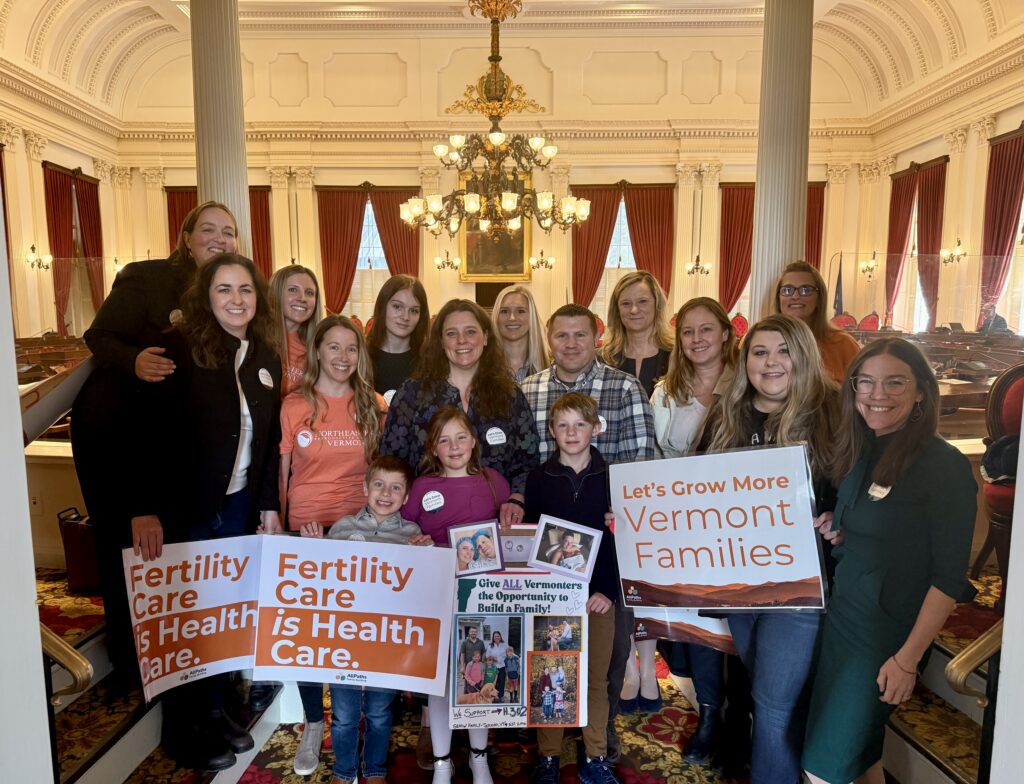
VT Fertility Advocacy Day April 10 2025
While we’re still not sure if Seven Days VT will publish this piece, we wanted to share it with our community because – almost one year to the day after Vermont’s first Fertility Advocacy Day – VT families are still no closer to having insurance coverage for fertility healthcare. Vermont remains the only state in the Northeast that does not have a fertility insurance law, and while our most recent bill H.302 bill will sadly not advance this session, we are not done fighting for current and future Vermont families.
______________________________________
As a family formation lawyer and reproductive rights advocate I am acutely aware of the lengths individuals go to in order to have a child. I have direct experience helping clients navigate cost, emotions, medical care, and legalities in their family building. And though I have lost count of the number of heartbreaks I have witnessed as hopeful parents discover their insurance covers zero percent of the care they require to have a child, I have not walked in their shoes.
A colleague, friend, mom of 3, and proud Vermonter recently shared with me that she once considered leaving Vermont, the place she calls home. It wasn’t because she didn’t love Vermont. She did. She loved the pristine nature, and the small, safe, walkable towns. A state that values education, hard work, and discipline. She loved living in a state where community means something – where neighbors truly support one another. And she loved living in a state where helping people is at the heart of policy. She wanted to raise her children there. But she didn’t know if she could afford to have those children there. So she and her wife considered leaving.
My friend required the assistance of assisted reproductive technology (ART) in order to have her children. And Vermont, unlike every other New England state, has no comprehensive fertility insurance mandate. This means that IVF, IUI, and other reproductive treatments are simply out of reach for so many hopeful parents. It means that Vermonters must decide whether they can spend thousands of dollars on fertility treatment, or simply move across state borders where the same is covered.
And increasingly, that is what they do.
They move to Massachusetts. To Connecticut. To Maine. To states that have made a policy decision: if you value families, you invest in helping them begin. Vermont had the option to make this same policy decision last legislative session in the form of HB 302, but cited economic concerns. It’s important to note here that HB 302 would mandate that insurance companies and not the state provide coverage for reproductive care.
So it should have come as a shock to no one that Vermont reported continued declining birth rates again last year. Vermont recorded just over 5,000 births in 2023, with a fertility rate of 42.1 births per 1,000 women – the lowest in the country. That is not just a statistic, it’s a signal. Low birth rates are not only demographic – they are fiscal. They mean a shrinking tax base over time, with fewer people paying into systems to fund schools, infrastructure, and healthcare – the very things that make Vermont such an incredible place to live are at risk.
We often talk about family building as a matter of personal choice, but this is also a matter of state economics. When hopeful parents leave a state, it doesn’t only equate to a loss of residents in numbers, it is a loss of participation, a loss of income tax revenue, consumer spending, property investment, and community. Departing families take with them the future workers their children would become and community members that will care for Vermont. Families are not short term assets – they are long term economic foundations that shape generational stability and the overall health of a society. And when families leave at the very moment they are trying to have children the loss compounds. Families are not just part of the state’s culture -they are central to its economic future.
This is the conversation we are not having enough. We talk about workforce shortages. We talk about aging populations. We talk about how to attract talent and retain young professionals. And we even talk about (and did) make childcare more affordable for Vermont parents. But we do not talk enough about the people who want to raise families in Vermont but cannot afford to start their families here.
Research consistently shows that states with fertility coverage mandates see higher utilization of assisted reproductive technology, and ultimately, more births. Cost is the single greatest barrier to accessing this care. This is not theoretical. It is policy with measurable economic outcomes.
And still Vermont hesitates.
Children raised in Vermont are more likely to remain in Vermont. They attend local schools, enter the local workforce, and contribute to the local economy. They stabilize and participate in communities and sustain demand for housing, healthcare, education, and small businesses. If we lose the future children of Vermont schools will close, housing markets will slump, and labor shortages will increase.
And beyond economic concerns the people impacted are not abstract. They are couples sitting at their kitchen table running numbers to see if they can afford the fertility treatment necessary to have a child – before even factoring in the cost to care for that child. They are single parents by choice delaying timelines that biology does not pause for. They are LGBTQ couples told that their path to parenthood is elective – something extra. They are Vermonters; and they are leaving, taking the future of Vermont with them.
If Vermont wants to keep families Vermonters have to support family-building. A fertility mandate will not solve every demographic challenge Vermont faces, but it is a clear, tangible statement of Vermont’s policy. It says that Vermont understands modern families are built in many ways, and Vermont will not make those paths to parenthood available only to the wealthy. It promises those who choose to call Vermont home: you can stay here. You can build your life here. You can grow your family here.
My friend stayed in Vermont. She and her wife have three beautiful children together that have the privilege of calling Vermont home. And my friend spends everyday trying to make the same possible for the remaining hopeful parents in Vermont and beyond. Until she does, Vermont will continue to lose residents to other New England states. And we are left questioning not only who is leaving, but what does Vermont become if they do?